



In brief: the fitting room is where browsing turns into buying and it's the room most stores manage least. Measure what happens in there, coach your team for the moments inside it and fitting room conversion becomes a lever you can pull.
Most stores watch the till closely and the fitting room barely at all. So the room where shoppers make up their minds is often the one nobody's running.

Picture a quiet Tuesday afternoon. A bloke has been circling the shirts for a while. He's got three over his arm and he's standing by the fitting rooms, waiting for someone to notice him.
Two staff are at the counter, catching up on the weekend. Nobody's being lazy. The floor's tidy and it feels like downtime. But he's the most valuable customer in the store, and he's about to hang the shirts on a rail and leave.
If you run a store, you've probably felt this without having a name for it. Plenty of footfall, plenty of browsing and a sales number that doesn't move the way the traffic does.
That gap is your retail conversion rate and the fitting room sits right in the middle of it.
Why does the fitting room matter so much for sales conversion?
Someone who takes clothes into a fitting room has stopped browsing. They've picked something, carried it across the store and decided it's worth getting changed for. Short of walking to the till, that's the strongest buying signal a shopper gives you.
It's also the moment they're most likely to talk themselves out of it. The size is wrong. The colour looks different under the lights. They're unsure about the fit and there's nobody to ask.
Each of those is a sale that was nearly made. If trying on is where intent peaks, the fitting room should be the best-run room in the store. In most stores it's a corridor with curtains, checked when someone remembers.
The room where shoppers make up their minds is often the one nobody's running.
What does a good staff member do in the fitting room?
Watch a strong sales assistant and the fitting room looks different. They spot the shopper with an armful before that shopper has to go looking for help. They open a room, hang the clothes and say they'll check back.
Then they actually check back. No hovering, just a quick "How's the fit?" through the curtain. That's when the next size comes over, or the belt that goes with the chinos.
Sometimes it's the honest opinion: "The navy suits you better than the grey." None of that is pushy. It's the service people say they want and rarely get. It turns "I'll think about it" into "I'll take both".
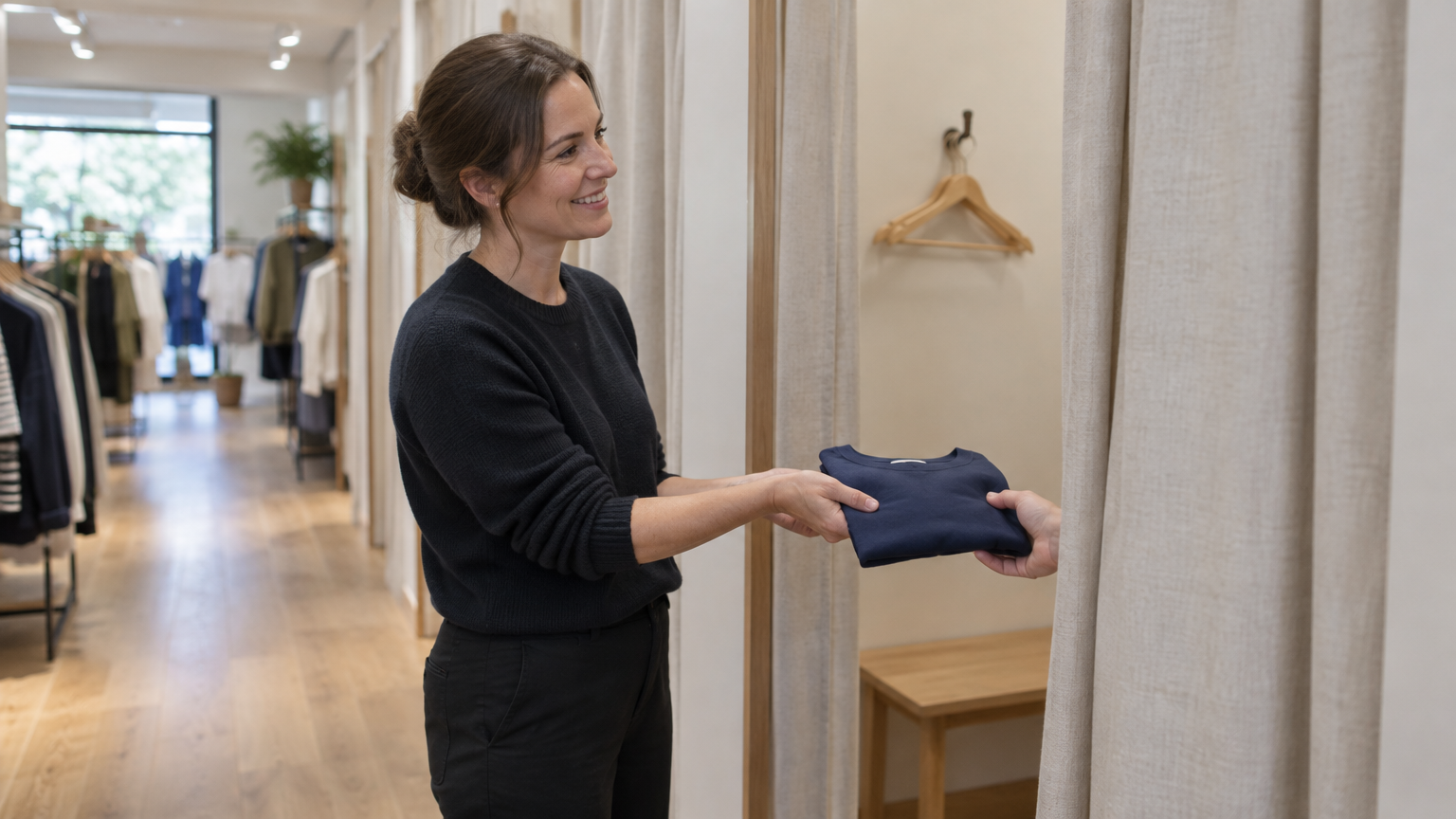
The other version is just as easy to picture. The shopper waits by a locked door, gives up on the second size and leaves the pile on the chair. Nobody saw it happen, so nobody can fix it.
If foot traffic is up, why aren't sales?
This is the question store managers ask us most. The door counts look healthy, people are staying longer and the takings still don't match. It feels like a traffic problem. Usually it isn't.
When people are coming in and lingering, the issue is what happens once they're inside. That's a conversion problem. Conversion problems live on the shop floor, not in the centre's footfall report. The fitting room is one of the first places to look.
What should you measure in the fitting room?
Most retailers track two things: people through the door and transactions at the till. That leaves out the middle of the story, everything between the door and the counter.
Bellwether's Spatial Density Sensors measure the fitting room area as its own zone. You see how many people go in and how long they spend there, separate from the store as a whole.
Cross-referenced with till data, that shows how often a fitting room visit ends in a sale. Three measures tell three different stories:
- Capture rate. Store visits to fitting room entries. It shows whether people engage with product enough to try it on. Miss it and a layout, merchandising or staffing problem never reaches the till.
- Fitting room dwell time. Whether customers get real time and attention in the room, or rush through. Miss it and you can't tell if the room itself is doing its job.
- Fitting room-to-purchase conversion. Of the people who tried something on, how many bought. Miss it and you can't separate a product problem from a service problem.
A store can have healthy footfall and still lose sales at any one of these points. Without the fitting room in view, all three collapse into one unhelpful figure: total conversion.
Data finds the gap. Coaching closes it.
Knowing your capture rate dipped tells you where to look. It doesn't tell your team what to do differently tomorrow morning. That's the job of structured retail staff training.
Bellwether's GMCU framework turns the data into behaviour you can teach and watch for at each stage of the visit (Turn Browsers into Buyers):
- Greet. Acknowledge every customer soon after they walk in, including the one heading for the fitting rooms.
- Meet. Ask what they're actually looking for, so the right sizes go into the room first time.
- Close. Check back through the curtain and give a clear path to the till before hesitation wins.
- Upsell. Offer the one thing that genuinely goes with what they're trying on.
For a store manager, that makes the fitting room something you can coach. Pick one moment for the week, say the check-back. Watch for it on the floor, talk about it at the morning huddle, then see whether the fitting room numbers move.
None of that needs new stock or a bigger store. It needs staff who know what good looks like and a way to see whether it's working. That's how our retail coaching is set up.
What to ask before you blame traffic
Before deciding a soft month is about footfall, pricing or the economy, check three things in the fitting room:
- What's your capture rate? How many store visitors actually go into the fitting room? If it's low, the issue may sit earlier: merchandising, greeting or product visibility.
- What's your fitting room-to-purchase rate? Of the people who tried something on, how many bought? A low number with a healthy capture rate usually points to service inside the room, not the product.
- Is anyone coaching to these numbers? A monthly sales report tells a manager the outcome. A framework tied to greeting, fitting room help and closing tells the team what to do differently.
None of this replaces good product, fair pricing or real footfall. But when the store's busy and conversion still won't budge, the fitting room is usually where the answer's hiding.
So next time the floor's quiet and the team's at the counter, glance over at the fitting rooms. Someone might be standing there with three shirts over his arm.
Your sales report tells you what sold. Bellwether shows you how fitting room conversion is tracking, hour by hour.
See which hours your fitting rooms turn browsers into buyers, and which they don't. Book a demo.
Frequently asked questions
Why does fitting room usage affect overall sales conversion so much?
Trying something on is the clearest sign a shopper is ready to buy. Help them at that moment and more try-ons become sales. Leave them alone and the same moment becomes the reason they walk out.
If foot traffic is up, why would conversion fall?
Traffic measures how many people show up. Conversion measures how many of them buy. More people inside doesn't mean more people helped, so the two can move in opposite directions.
Is long fitting room dwell time a good or bad sign?
It depends what's happening during it. Longer dwell time with active staff help and real product consideration is a good sign. Longer dwell time with a customer left alone to decide often points to a missed sale.
Can better fitting room coaching fix a conversion problem on its own?
It's one lever. It works best alongside healthy stock, fair pricing and real footfall. But staff behaviour at the fitting room is one of the fastest things to change and measure. You don't need a new season's stock to test it.


